Introduction
Higher education is at a crossroads. Rising student expectations, faculty workload pressures, and institutional demands for efficiency are converging at a time when artificial intelligence is reshaping nearly every industry. Recent data from Gartner suggests that AI and hyperautomation are now “fundamental components” of the teaching mission, with nearly two-thirds of institutions already implementing or developing formal AI frameworks. The question is no longer if AI will transform education, but how quickly institutions can adapt.
Market Overview
The global market for AI in education is on a massive trajectory. According to Grand View Research, the sector is projected to reach $32.27 billion by 2030, while HolonIQ anticipates that technology will be the primary driver as global education expenditure hits $10 trillion. This growth is fueled by a desperate need for personalized learning and automated grading. Colleges face increasing competition to attract students who expect digital-first experiences, while faculty are under pressure to deliver engaging instruction alongside rigorous research duties.
Pain Points
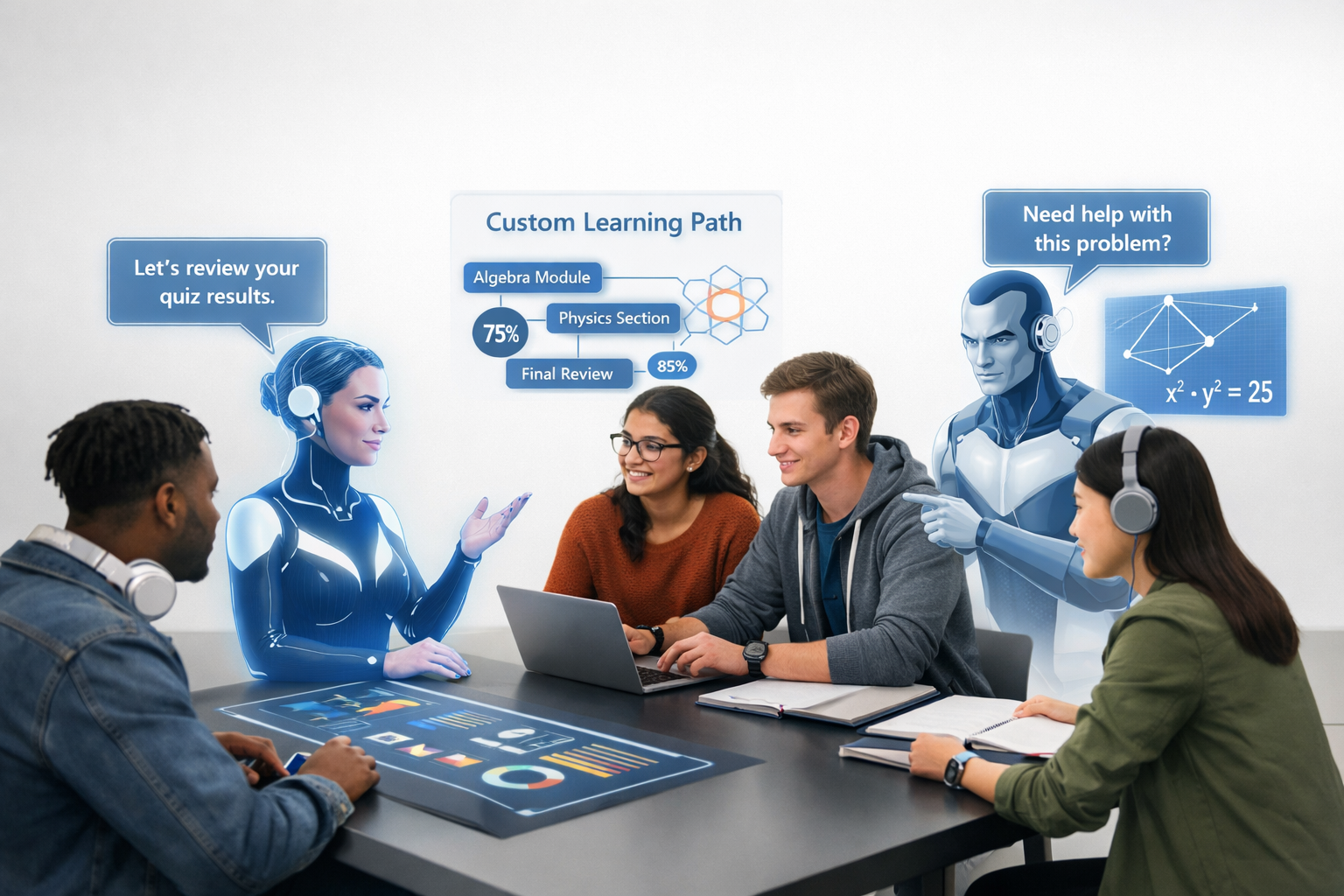
Tutor AI is a configurable, institution‑grade tutoring platform that augments teaching and learning while preserving academic integrity and instructor control. It connects three stakeholder layers—students, faculty, and university administrators—through curated knowledge, adaptive pedagogy, and actionable analytics.
For students, the primary challenge is access. A 2025 HEPI survey found that while 92% of students are now using AI, many feel they lack the institutional support to use it effectively.
Meanwhile, professors are grappling with “technostress” and administrative bloat. Research from Cengage highlights that course preparation and student communication now occupy nearly 40% of faculty time, leaving little room for mentorship. Universities, in turn, struggle with retention rates and the need to demonstrate measurable outcomes to stakeholders.
Faculty‑Controlled Knowledge and Governance
- Curated Subject Modules: Faculty can upload, edit, or lock subject‑specific content (syllabi, reading lists, model answers, assessment rubrics) so the AI’s guidance is grounded to actual coursework and aligns with course objectives.
- On‑Demand Updates: Instructors can push targeted updates (new readings, changed grading policies, topical clarifications) that immediately refine the AI’s responses for their classes.
- Configure Tutor Modes: Faculty can choose which modes students have access to.
University Visibility and Insights
- Usage Dashboard: Administrators get a unified dashboard showing adoption metrics, peak usage times, topic hotspots, and student engagement by cohort.
- Learning Outcomes Analytics: Aggregated signals—concept mastery rates, common misconceptions, time‑to‑competency—help institutions identify at‑risk students and curriculum gaps.
- Policy & Compliance Controls: Role‑based access and audit logs make it straightforward to meet institutional policies and accreditation requirements.
Student‑Facing Modes
- Guided Study Mode (Explore)
- Purpose: Foster problem‑solving skills and conceptual understanding.
- Behavior: Offers structured approaches, hints, and Socratic prompts without giving final answers; nudges students toward discovery and reasoning.
- When to Use: Homework practice, formative learning, early topic exposure.
- Rapid Revision Mode (Recap)
- Purpose: Enable efficient review before exams or tutorials.
- Behavior: Presents concise summaries, concept maps, and prioritized flashpoints tailored to the course syllabus and the student’s weak areas.
- When to Use: Pre‑exam cramming, quick refreshers between classes.
- Solution Assist Mode (Resolve)
- Purpose: Provide authoritative, instructor‑aligned solutions when direct answers are appropriate.
- Behavior: Delivers step‑by‑step solutions, alternative approaches, and source citations; faculty can restrict this mode for graded assessments.
- When to Use: Worked examples, lab walkthroughs, post‑assessment feedback.
How This Maps to the Pain Points
- For Students: Personalized, always‑available support that scaffolds learning rather than shortcutting it—reducing confusion and improving confidence.
- For Faculty: Automation of routine tasks and a platform to enforce pedagogical standards, freeing time for high‑value interactions.
- For Universities: Institutional oversight and measurable impact on retention, throughput, and student satisfaction.
This modular design makes Tutor AI both practical to deploy and easy to govern, enabling colleges to adopt AI‑driven tutoring without sacrificing control, quality, or accountability.
Impact & Benefits
The adoption of Tutor AI delivers measurable improvements across the academic ecosystem, aligning with what McKinsey describes as the “AI High Performer” model—organizations that use AI to drive transformative innovation:
- Efficiency Gains: Professors report up to a 40% reduction in time spent on grading and routine admin.
- Student Success: Personalized tutoring improves comprehension and retention by adapting to each learner’s unique pace.
- Institutional Value: Proactive interventions based on AI analytics help boost graduation rates and student satisfaction scores.
- Cost Savings: Streamlined processes reduce overhead while simultaneously enhancing the quality of the educational product.
Call to Action
The future of higher education lies in embracing tools that amplify human teaching rather than replace it. Tutor AI represents a strategic advantage for institutions ready to modernize. If your college is seeking to improve student outcomes, reduce faculty burnout, and strengthen institutional performance, now is the time to act.
Explore how our Tutor AI can become your partner in academic excellence. See Tutor AI in action: run a classroom pilot to validate outcomes and gather faculty and student feedback before full deployment.
Connect with us at support@intopus.com